
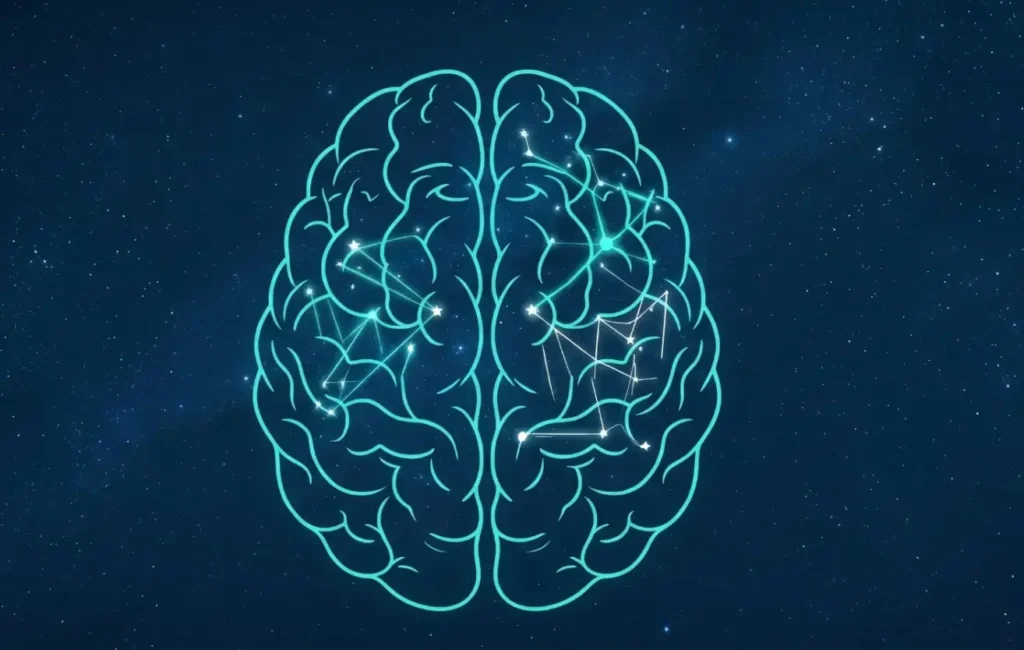
Kristina Agustin, Founder of Southern Sky AI, on how the neuroscience of the brain’s two hemispheres can help leaders decide where AI genuinely belongs in their organisation — and where it does not.
If we divided work and organisational structure along the familiar lines of left brain for logic and reason, right brain for creativity (which, it turns out, is only partly true), we can start to think about how I think about where AI belongs in an organisation.
The Neuroscience Behind the Question
Last year I attended a workshop with Dr Arthur Brooks, a Harvard professor who researches the science of human happiness. He drew on the neuroscience of hemispheric lateralisation — the left and right sides of the brain — to describe something more precise.
The left hemisphere processes information and produces answers. These are complicated problems: analysis, logic, efficiency, sequential reasoning, computation. Difficult, but solvable through expertise and the right tools.
The right hemisphere holds the questions that cannot be computed. These are complex problems: relationships, judgment, trust, meaning, values, ethics. These belong to humans.
Professor Brooks frames AI as the ultimate left-brain device. Outstanding at complicated problems and categorically unsuited to complex ones.
“Never solve a complex need with a complicated tool.”
— Dr Arthur Brooks, Harvard professor
From the Chart Room
The practical question I ask before any implementation conversation is this: is the problem left brain or right brain?
If it is left brain — drafting, scheduling, compliance cross-referencing, data aggregation — AI belongs in the conversation. If it is right brain — a client relationship built on demonstrated reliability, a crew welfare conversation, a hiring decision, a cultural call about how an organisation operates — the question shifts to what this situation needs from a person.
Which Problems Don’t Belong to AI
When I work through this with an organisation, I usually start with the same questions.
Where is significant time going to complicated work that a structured system could carry instead?
Documentation, compliance cross-referencing, voyage reporting, data aggregation: left-brain problems, all of them. Every hour reclaimed from that category is an hour available for the complex work that only humans can do.
Which decisions are being treated as complicated when they are, in fact, complex?
AI applied to crew hiring is one to examine carefully. Any tool used in that process draws on historical hiring data, and that data carries the preferences, conscious and otherwise, of whoever made those decisions before.
There are other decisions in a maritime operation that sit in the same category. Recognising which ones require that kind of scrutiny, and keeping a person accountable for the outcome, is the work that cannot be delegated to the model.
If your team were freed from the complicated work, would they have the capacity and the direction to do the complex work better?
The reclaimed time is only valuable when it goes toward the right problems. Those are the human ones: relationships, judgment calls, decisions that carry real consequences.
They also include the human layer on top of the complicated work — the person who reads the output, questions the assumption, and decides whether the answer the system produced is the right one.
The full article covers the neuroscience behind hemispheric lateralisation, the paperclip thought experiment and why human oversight is non-negotiable, the historical data bias problem in recruitment, and a classification framework for applying the left brain / right brain lens to your own organisation’s decisions before any implementation work begins.
Written by Kristina Agustin, Southern Sky AI. Contact contact@southernsky.ai.