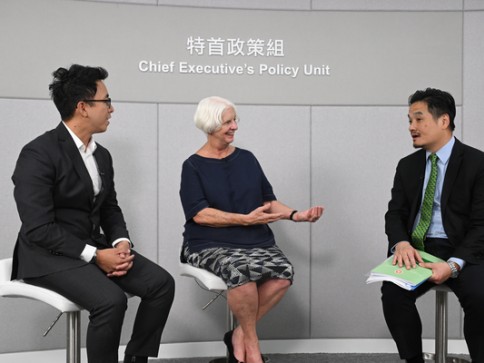
Hong Kong Boating Industry Association Chair Lawrence Chow and Asia-Pacific Superyacht Association Executive Director Suzy Rayment were interviewed by Dr Stephen Wong Chief Head of the Chief Executive’s Policy Unit about measures announced in the 2025 Policy Address to develop Hong Kong’s yacht economy. The Chief Executive’s Policy Unit hosted a roundtable discussion on the yacht economy in March, gathering insights from industry leaders, Legislative Council members and government bureaus. (Courtesy of Chief Executive’s Policy Unit).
In the recent 2025 Policy Address, Chief Executive John Lee proposed, for the first time, to develop the city’s yacht economy, and to establish Hong Kong as a key yachting hub in Asia. Hong Kong boasts 1,180km of shoreline and 263 islands, making it ideal for yachting. Initiatives will include providing 600 additional yacht berths at the former Lamma Quarry, expansion of the Aberdeen Typhoon Shelter, and the Hung Hom Station waterfront projects, and a planned yacht bay at Airport City, which will include berths that can accommodate superyachts of over 80m in length.
Dr Stephen Wong, Head of the Chief Executive’s Policy Unit (CEPU) recently held a discussion with prominent figures in the yachting industry to explore the sector’s prospects. He highlighted that there are new measures in place that mean incoming boats can avoid prior booking, giving seafarers greater convenience.
Hong Kong Boating Industry Association Chair Lawrence Chow agreed that this is a positive development, applauding, “easing regulations and making it more convenient for visiting yachts to come to Hong Kong with these new anchorage spaces, and also streamlining the customs, immigration and quarantine facilities.”
The Policy Address also provided details of the proposals for a marina at the Airport City. Asia-Pacific Superyacht Association Executive Director Suzy Rayment stressed the importance of welcoming more high-spending visitors, and remarked that the superyacht industry brings a full ecosystem of jobs and services to Hong Kong. “For example, you need to have berthing, fuelling and provisioning, and so Hong Kong as a whole benefits from these yachts coming in, because they spend a lot of money,” she said.
Ms Rayment also added that many yacht owners manage their vessels through family offices, and that they may also own private jets or have a helicopter on their yachts. For Mr Wong, the emphasis on high-value yacht owners aligns well with the city’s strategy of attracting family offices, as well as its efforts to build the city’s reputation as an art trading hub.
Complementing this perspective, Mr Chow said that more boats coming in will mean more career opportunities for captains and crew, a growing role for the maintenance sector, and new opportunities for Hong Kong’s mega event industry. “When we have, for example, the Hong Kong Marina there, it could possibly host some international events in the heart of the city. That really puts Hong Kong on the map.”
Mr Wong also underlined Hong Kong’s strategic role in connecting regional yacht communities, as well as its potential to serve as a springboard into the Greater Bay Area. He said the Asia-Pacific Superyacht Association is active in organising prestigious events, such as international yacht shows and superyacht summits that attract important business travellers. Ms Rayment explained that the association works across the Asia-Pacific area with its regional neighbours including Singapore, Malaysia, Thailand and Japan. She described Hong Kong as a fantastic hub because of its well-established boating community, which includes 70-plus superyacht owners. “And if we add in the Greater Bay Area, that is going to be quite amazing.”
The industry stakeholders applauded the CEPU’s co-ordination efforts, including its hosting of a roundtable discussion on the yacht economy in March. The forum gathered insights from industry leaders, Legislative Council members and government bureaus. Mr Chow praised the rapid progress made so far and the way the CEPU has brought together different stakeholders, commenting “It means a lot.”
Ms Rayment affirmed that industry associations can offer information of a technical nature that will be invaluable to policy-makers going forward. Mr Wong added that the CEPU looks forward to collaborating further with industry players to help Hong Kong’s yacht economy develop its potential.
https://www.news.gov.hk/eng/2025/10/20251028/20251028_164113_408.html